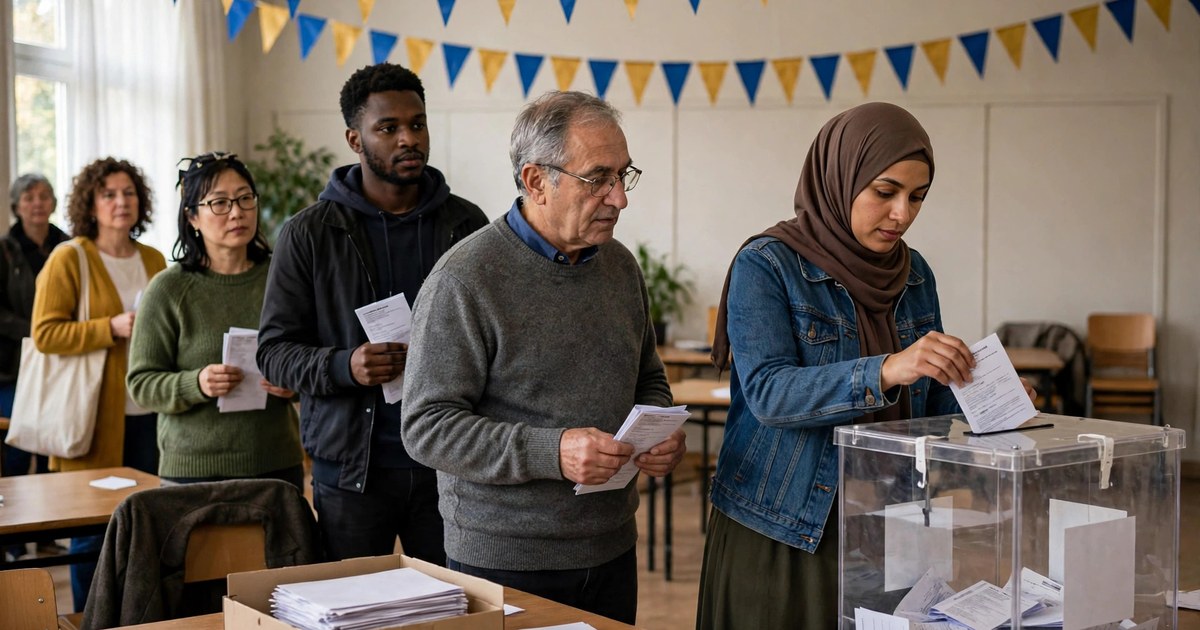
Every five years, hundreds of millions of voters across the European Union choose the people who will represent them in the European Parliament. It is one of the largest democratic exercises in the world, second only to India’s general election in scale. Yet outside Europe, the vote is often treated as a local event with local consequences. That is a mistake. The Parliament elected in Brussels and Strasbourg helps decide rules on trade, technology, climate, migration and product standards that reach far beyond the EU’s borders. This explainer sets out how European elections actually work, why the system looks different from a national election, and why the results matter to governments, businesses and ordinary people who may never set foot in Europe.
What exactly is being elected?
The European Parliament is the EU’s directly elected law-making body. It currently has 720 members, known as MEPs — Members of the European Parliament. Together with the Council of the European Union, which represents national governments, the Parliament passes most EU legislation, approves the EU budget, and gives or withholds consent to international agreements, including trade deals.
Voters do not elect the European Commission, the EU’s executive arm, directly. However, the Parliament must approve the Commission President and the team of Commissioners before they can take office, and it can dismiss the entire Commission through a vote of censure. That gives election results real weight in deciding who runs the EU’s day-to-day machinery.
Who can vote, and where?
Every citizen of an EU member state is also an EU citizen, and EU citizens aged 18 or over — 16 in a small number of countries — can vote in European elections. Unusually, citizens living in another EU country can choose to vote there, for candidates standing in their country of residence, instead of voting back home. Turnout is compulsory in a few member states, including Belgium and Luxembourg, and voluntary everywhere else.
Each country organises its own vote under its own electoral law, within common EU principles. Voting usually takes place over several days, from Thursday to Sunday, because member states have different traditions about which day elections are held. Results cannot be announced until the last polling stations in the EU have closed, so that voters in one country are not influenced by outcomes in another.
How seats are divided between countries
Seats are allocated by a principle called degressive proportionality. Larger countries elect more MEPs than smaller ones, but smaller countries are deliberately over-represented compared with a strict population share. Germany, the most populous member state, elects 96 MEPs. Malta, the smallest, elects six. The idea is to balance two goals: reflecting population, while making sure even the smallest member state has enough representatives to cover the main political viewpoints of its voters.
Within each country, seats are won through proportional representation. Parties present lists of candidates, voters choose a party — and in many countries can also express a preference for individual candidates — and seats are then shared out in proportion to votes. Most countries apply a threshold, often up to five percent, below which a party wins no seats. This is very different from first-past-the-post systems, and it means smaller and newer parties can enter the Parliament with a relatively modest share of the vote.
Political groups: the Parliament’s real parties
Once elected, MEPs do not sit by nationality. They join transnational political groups organised by ideology — centre-right, social democratic, liberal, green, conservative, left, and others. These groups, not national parties, are the working units of the Parliament. They negotiate compromises, divide up committee chairs and rapporteur roles, and decide how their members will vote on most files.
To form a recognised group, MEPs must meet minimum requirements for numbers and for representation from several member states. Group membership matters practically as well as politically: recognised groups receive funding, staff and speaking time. It also matters for interpretation. A shift in seats between groups tells you far more about the direction of EU policy than the result in any single country.
How the Commission President is chosen
After the election, the European Council — the heads of state or government — proposes a candidate for President of the European Commission, taking the election results into account. Since 2014, the main political groups have promoted lead candidates, often called by the German term Spitzenkandidaten, during the campaign. The system is informal and has been applied inconsistently, but the logic is democratic: the group that performs best argues that its lead candidate has the strongest claim to lead the Commission.
The Parliament then votes on the proposed President. If the candidate fails to win a majority of MEPs, the European Council must propose someone else. Later, the full team of Commissioners — one from each member state — faces individual hearings in parliamentary committees and a single vote of approval. Parliament has used these hearings to force the replacement of candidates it judged unsuitable, which shows that the post-election process is not a formality.
Why turnout matters — and why it has been low
For decades, turnout in European elections fell at every cycle, dropping below 43 percent in 2014 before recovering to just over 50 percent in 2019 and holding around that level in 2024. Analysts often describe these as "second-order" elections: voters treat them as less important than national votes, use them to protest against their own government, and campaigns are still run largely by national parties on national issues.
That creates a paradox. The Parliament’s powers have grown with every EU treaty reform, so the institution voters take least seriously is more powerful than ever. Low turnout also skews representation, because older and more politically engaged citizens vote at higher rates than younger and less settled ones. Several member states have debated reforms — transnational lists, a single voting day, lowering the voting age — but change requires agreement across the whole Union and progress has been slow.
Why the results matter beyond Europe
First, trade. The Parliament must consent to EU trade agreements, and it has not hesitated to delay or reshape deals when concerns about environment, labour standards or agriculture arise. Exporters in Asia, Africa and the Americas who sell into the EU market are affected by standards the Parliament helps set, from chemical safety to deforestation rules for imported goods.
Second, technology and data. Landmark EU laws on data protection, digital markets and artificial intelligence were co-decided by the Parliament. Because the EU market is large and wealthy, companies often apply EU rules globally rather than maintaining separate systems — a phenomenon researchers call the Brussels Effect. An election that shifts the balance between pro-regulation and deregulation-minded groups therefore changes the environment for technology firms worldwide.
Third, climate and energy. The Parliament co-decides emissions targets, carbon pricing and vehicle standards. Those choices influence global supply chains, shipping, aviation and the price signals facing energy exporters.
Fourth, migration and foreign policy. While foreign policy remains mainly in national hands, the Parliament controls budget lines, must approve many international agreements, and uses resolutions and hearings to shape debate. Its stance affects development funding, enlargement policy toward candidate countries, and support programmes that reach well beyond Europe.
Common misunderstandings
One frequent claim is that the Parliament cannot propose laws. That is broadly true — the formal right of legislative initiative belongs to the Commission — but incomplete. The Parliament can formally request that the Commission propose legislation, it can amend or reject almost any proposal, and in negotiations its amendments regularly survive into final law. Another misunderstanding is that MEPs vote as national blocs. Voting records show group discipline is usually stronger than national loyalty, except on issues with a direct national interest, such as agriculture or fisheries allocations.
Finally, European elections do not choose a single "government of Europe" in the way a national election chooses a government. Power in the EU is deliberately dispersed among the Parliament, the Council, the Commission and member states. Elections shift the balance within that system rather than handing total control to a winner — which is precisely why reading the results requires looking at group totals, coalition possibilities and the Council’s composition together.
Frequently Asked Questions
How often are European elections held?
Every five years, across all EU member states, usually in late spring.
How many members does the European Parliament have?
720 MEPs, divided among member states by degressive proportionality, from 96 for Germany down to six for the smallest states.
Can EU citizens living abroad in another EU country vote?
Yes. They can choose to vote in their country of residence or in their country of origin, but not both.
Do voters elect the European Commission President directly?
No. The European Council proposes a candidate taking election results into account, and the Parliament must elect that candidate by majority vote.
Why do results come out on the same night for all countries?
Counting and publication are held back until the last polling stations in the EU close, so early results cannot influence voters still casting ballots elsewhere.
Sources / Note
This explainer is based on the types of sources that govern and document the process directly: the European Parliament’s official electoral procedure and results publications, the EU treaties and the EU electoral act as published on EUR-Lex, Eurostat population data used for seat allocation, and European Parliamentary Research Service briefings. Figures such as the total number of seats reflect the composition set for the current parliamentary term and should be checked against the Parliament’s official site before republication, as seat numbers are reviewed before each election.
Leave a Reply