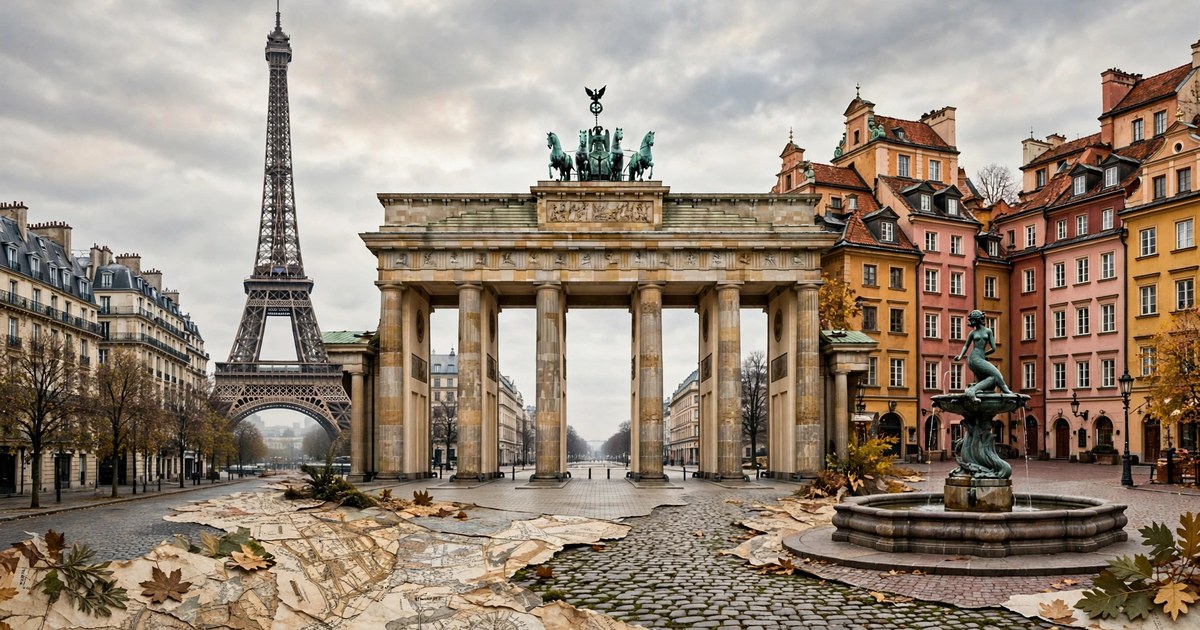
When European leaders gather to decide questions of war and peace, energy, money, or the future borders of the European Union, three capitals are watched more closely than most: Paris, Berlin, and Warsaw. France, Germany, and Poland do not decide Europe’s future alone. The other 24 EU member states, the institutions in Brussels, and partners such as Italy, Spain, and the Nordic and Baltic countries all matter. Yet the combined weight of these three — in population, economic output, military capability, and political influence — means that when they agree, the EU can usually move, and when they disagree, it often slows down.
Why These Three Matter: People, Money, and Military Weight
Together, France, Germany, and Poland account for roughly 190 million people, well over 40 percent of the EU’s population of about 450 million. Germany is the EU’s most populous member state, with more than 84 million residents, followed by France with around 68 million and Poland with around 37 million.
Their economic weight is just as significant. Germany has the largest economy in Europe, built on manufacturing, engineering, and exports. France has the EU’s second-largest economy, with strengths in aerospace, energy, agriculture, finance, and defence. Poland, while smaller, has become the largest economy in central and eastern Europe and one of the EU’s fastest-growing economies over three decades.
Military weight completes the picture. France is the EU’s only nuclear power since the United Kingdom left the Union, maintains armed forces designed for operations beyond Europe, and holds a permanent seat on the United Nations Security Council. Germany, after decades of restraint, has committed to a major rebuilding of the Bundeswehr and now has one of Europe’s largest defence budgets in absolute terms. Poland has expanded its military rapidly, spending a higher share of national income on defence than any other NATO ally in recent years, and building up its land forces along NATO’s eastern flank.
The Franco-German "Engine" of the EU
For most of the history of European integration, the central relationship was not a triangle but a pair: France and Germany. Reconciliation between the two former wartime enemies was the founding purpose of the European Coal and Steel Community in 1951 and the European Economic Community in 1957.
The partnership was formalised in the Élysée Treaty of 1963 and renewed by the Treaty of Aachen in 2019. A pattern developed that observers called the Franco-German "engine" of Europe. Before major summits, French and German leaders would meet, reconcile their different instincts — France favouring political ambition and European strategic autonomy, Germany favouring fiscal discipline and strong rules — and arrive in Brussels with a joint proposal. Others could amend it, but it often set the agenda.
The engine produced major steps, including the single market, the creation of the euro, and, in 2020, agreement on joint EU borrowing for the post-pandemic recovery fund, a step Germany had long resisted. Still, for sixty years the assumption in Brussels was simple: without Franco-German agreement, major progress was unlikely.
Poland’s Rising Role, Especially Since 2022
Poland was never absent from European politics. As the largest country to join the EU in 2004, it brought a strong Atlanticist outlook, close ties to the United States, and a historical experience of Russian and Soviet domination that shaped its view of security. Warsaw argued for years that Europe underestimated the risk from Russia and depended too heavily on Russian energy.
Russia’s full-scale invasion of Ukraine in February 2022 changed Poland’s standing dramatically. Poland became the main logistical gateway for Western aid to Ukraine, hosted more Ukrainian refugees than any other EU country in the first phase of the war, and emerged as one of Kyiv’s most vocal advocates in both the EU and NATO. Arguments Warsaw had made for a decade about deterrence and energy security suddenly looked prescient.
At the same time, domestic politics affected Poland’s influence. Disputes with Brussels over the rule of law, which intensified after 2015, limited Warsaw’s ability to build coalitions and led to EU funds being withheld. The change of government in late 2023, which brought a pro-EU coalition to power under Donald Tusk, a former president of the European Council, reopened channels with Brussels and Berlin and made three-way cooperation practical again. Poland’s influence today rests on its security role on the eastern flank and a renewed effort to be present where EU compromises are drafted.
The Weimar Triangle: A Format With a Purpose
The three countries have a formal framework for meeting: the Weimar Triangle. Created in 1991, shortly after the Cold War, by the foreign ministers of France, Germany, and the newly democratic Poland, it takes its name from the German city of Weimar, where the first meeting took place. Its original purpose was to anchor Poland in Western structures and support its path toward NATO and EU membership, achieved in 1999 and 2004 respectively.
For long periods the format was more symbolic than decisive. Since 2022, and especially since 2024, it has been revived as a working format, with meetings of heads of government and foreign and defence ministers used to coordinate positions on Ukraine, European defence, and EU policy before wider summits. It brings western and eastern perspectives together in a group small enough to negotiate honestly, yet large enough to carry much of the Union if it reaches a common line.
Its limits are clear. It is not an institution, takes no binding decisions, and cannot replace the European Council, where all 27 member states sit. Its usefulness depends on whether the three governments want to use it — and whether other member states see it as a bridge for building wider agreement rather than a closed club.
Where the Three Agree
The clearest agreement is on Ukraine. All three governments support Ukraine’s sovereignty, have supplied military, financial, and humanitarian assistance, back EU sanctions on Russia, and support strengthening NATO’s eastern defences. There are differences of emphasis and speed, but not of direction.
They also broadly agree that the EU must take more responsibility for its own security. How far and how fast to go is still debated, but the principle — that Europe cannot assume permanent, unlimited American protection and must build stronger capabilities of its own — is now shared in Paris, Berlin, and Warsaw in a way it was not a decade ago.
On enlargement, all three accept in principle that the EU’s future includes Ukraine, Moldova, and the Western Balkan states, provided candidates meet the Union’s criteria on democracy, the rule of law, and economic reform. They also agree that enlargement requires the EU to reform how it decides and funds its policies, although they do not yet agree on what those reforms should be. All three are also committed to the single market and to EU competitiveness.
Where the Three Disagree
Energy is a long-standing fault line. France relies heavily on nuclear power and defends its place in Europe’s low-carbon future. Germany completed its phase-out of nuclear power in 2023 and built its strategy around renewables, efficiency, and imported gas in transition. Poland, historically dependent on coal, is moving toward a mix including its first nuclear power plants alongside renewables, while warning that climate policy must not outrun what its industry and households can afford. These models regularly collide in Brussels over EU climate and energy rules.
Fiscal policy is another divide. Germany has traditionally been the EU’s strongest advocate of strict budget rules and limited common debt. France has usually argued for more flexibility, more public investment, and greater willingness to borrow jointly for European priorities. Poland tends to sit between the two: cautious about arrangements that might reduce EU funds for less wealthy regions, but supportive of common spending on defence and infrastructure that benefits the east.
Defence procurement may be the most practical disagreement. France argues that European money should buy European equipment, strengthening the continent’s own defence industry. Germany balances that instinct against speed and interoperability, and has bought American systems when it judged European alternatives unavailable or too slow. Poland, rearming at speed since 2022, has bought heavily from the United States and South Korea as well as European suppliers, prioritising rapid delivery over industrial policy. Underlying these disputes are different strategic cultures: France’s instinct for autonomous action, Germany’s preference for multilateral process, and Poland’s reliance on the American security guarantee.
What This Means for the Rest of Europe
For other member states, a working triangle is both an opportunity and a concern. The opportunity is momentum. When countries representing more than 40 percent of the EU’s population align behind a proposal on Ukraine aid, defence funding, or enlargement, it starts with a strong chance of adoption, and smaller states can focus on shaping its details rather than building a majority from scratch.
The concern is exclusion. Governments in southern, northern, and smaller member states have periodically worried that a Paris-Berlin-Warsaw axis could set the terms of debate before others are heard — on fiscal rules affecting indebted southern economies, on energy rules, or on defence priorities weighted toward the eastern flank rather than the Mediterranean. The format’s health therefore depends on how the three use it. Used as a first step toward a wider compromise, it strengthens the Union. Used as a substitute for one, it breeds resentment and blocking minorities.
For neighbours and partners, the triangle is also a signal. A united position makes EU policy more predictable for Ukraine, candidate countries, and the United States. Visible friction invites outside powers to negotiate with capitals separately. The relationship is therefore a reliable early indicator of whether Europe will act together, or drift apart.
Frequently Asked Questions
What is the Weimar Triangle?
A forum for political cooperation between France, Germany, and Poland, founded in 1991 in Weimar, Germany. It holds meetings of leaders and ministers to coordinate on European and security policy, but takes no binding decisions.
Why is Poland more influential in the EU than it used to be?
Mainly because of security. Since 2022, Poland has become the key logistics hub for aid to Ukraine, a leading voice on eastern policy, and one of NATO’s highest defence spenders relative to its economy. A more cooperative relationship with Brussels since late 2023 has reinforced that role.
Do France, Germany, and Poland always agree on EU policy?
No. They agree on supporting Ukraine and on stronger European security, but regularly disagree on energy, EU budget rules and joint borrowing, and whether European defence money should buy only European-made equipment.
Can these three countries decide EU policy on their own?
No. EU decisions require agreement among all member states in the Council, often together with the European Parliament. The three carry great weight because of their size, but still need majorities with the other 24 countries.
Sources and Note
This article is an original explainer written for TheEuropeTimes.site and does not reproduce news agency copy or any single outlet’s reporting. Its factual framework rests on official government sources of France, Germany, and Poland, including foreign ministry publications on the Weimar Triangle and bilateral treaties; European Council and Council of the European Union documentation on summits, enlargement, and fiscal rules; Eurostat population and economic data; NATO defence expenditure figures; and analysis from established European policy research institutes specialising in EU affairs and security. Figures are given in rounded terms because such data are revised regularly; readers seeking exact current values should consult the latest Eurostat and NATO releases.
Leave a Reply