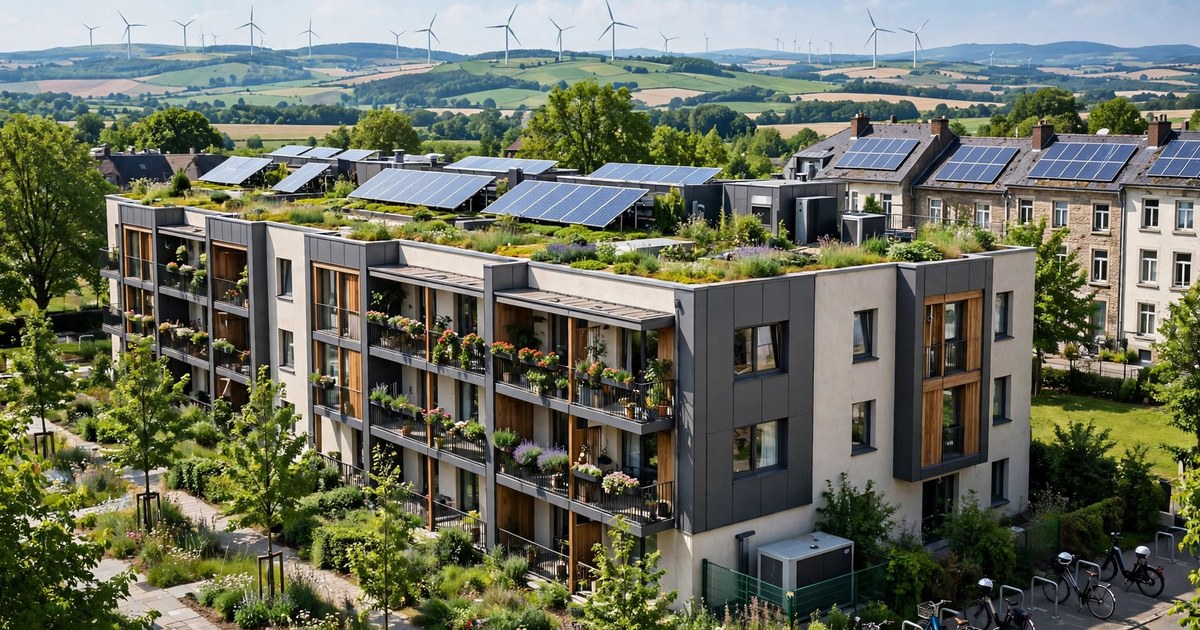
The European Green Deal is often described as Europe’s climate plan, but that description is too small. It is a broad programme to reorganise how the European Union produces energy, builds homes, moves people and goods, grows food and makes industrial products — with the goal of making the EU climate neutral by 2050. For ordinary people, the Green Deal is not an abstract treaty debate. It shows up in energy bills, in the cars available to buy, in renovation rules for houses, in the price of flights and heating fuel, and in new jobs in some industries and pressure on jobs in others. This explainer separates what the Green Deal legally requires from what is still political debate, and explains where households are most likely to feel it.
What the Green Deal actually is
Launched by the European Commission in December 2019, the Green Deal is an umbrella strategy, not a single law. Its legal backbone is the European Climate Law, adopted in 2021, which wrote two targets into binding legislation: the EU must reach net-zero greenhouse gas emissions by 2050, and by 2030 it must cut net emissions by at least 55 percent compared with 1990 levels. Because these targets are in law, later governments cannot simply abandon them without changing legislation.
Around that backbone sits a large package of individual laws, often grouped under the name "Fit for 55". These cover carbon pricing, renewable energy, energy efficiency, vehicle standards, land use and more. Some parts have been adjusted since 2024 as governments responded to energy prices, industrial competition and farmer protests — but the 2030 and 2050 targets themselves remain law.
Carbon pricing: the ETS and what it means for bills
The centrepiece of EU climate policy is the Emissions Trading System, or ETS. It sets a cap on emissions from power stations, heavy industry and aviation within Europe, and companies must hold allowances for each tonne they emit. The cap shrinks every year, and allowances are traded, which creates a carbon price. In plain terms: polluting becomes a cost of doing business, and cleaner production becomes cheaper by comparison.
A second system, often called ETS2, is scheduled to extend carbon pricing to fuels used in buildings and road transport later this decade. This is the part households will notice most directly, because it can raise the cost of petrol, diesel and heating fuels. To cushion the effect, the EU created a Social Climate Fund, financed from ETS revenues, intended to support lower-income households with renovation, cleaner heating and transport costs. How much protection people actually receive will depend heavily on how each national government spends its share.
Member states also receive large revenues from selling allowances. Those funds are meant to be reinvested in climate action, energy infrastructure and support for affected workers and regions, including through the Just Transition Fund for coal-dependent areas.
Cars, vans and the end of new petrol and diesel sales
EU law requires new cars sold from 2035 to have zero CO2 emissions, which in practice ends sales of new petrol and diesel cars, while leaving the existing fleet on the road. Car makers face steep interim targets before then, which is why manufacturers have expanded electric models and why charging networks are being mandated along major highways.
For households, the practical questions are price, charging access and running costs. Electric cars remain more expensive to buy in many segments, though total running costs are often lower. Rural drivers, people without off-street parking, and used-car buyers are the groups most exposed to transition problems, and several governments run purchase or charging subsidies for that reason. The regulation includes a review clause, and debate about e-fuels and the pace of the change continues — but buyers should plan around the direction of travel, not around the debate.
Homes: renovation, heating and energy labels
Buildings account for a large share of Europe’s energy use, and most of the housing stock was built before modern insulation standards. The revised Energy Performance of Buildings Directive pushes member states to renovate the worst-performing buildings first, sets trajectories for reducing residential energy use, and phases out incentives for stand-alone fossil-fuel boilers. New buildings must meet zero-emission standards from around the end of the decade, with earlier dates for public buildings.
For homeowners, this means energy performance certificates will matter more in sales and rentals, renovation support schemes are expanding, and gas boiler replacement decisions increasingly favour heat pumps or district heating. For tenants, the risk is that renovation costs are passed into rents; the opportunity is lower bills in a properly insulated home. Rules are implemented nationally, so deadlines and subsidies differ significantly between countries — always check your national or regional scheme rather than relying on EU-level headlines.
Energy: renewables targets and your electricity supply
The revised Renewable Energy Directive sets a binding target of at least 42.5 percent renewable energy in the EU’s overall energy mix by 2030, with an ambition toward 45 percent. Permitting for wind and solar projects is being sped up, and member states must designate areas where approvals are faster.
Households feel this through rooftop solar rules, community energy schemes, and electricity tariffs that increasingly reward using power when renewable supply is abundant. It also affects energy security: the rapid build-out after 2022 was driven as much by the wish to reduce dependence on imported fossil fuels as by climate goals, and that security argument continues to protect renewables policy even when climate politics become contentious.
Food, farming and nature
The Green Deal’s farm and nature components have been its most contested. The Nature Restoration Law requires member states to restore degraded ecosystems, with targets for habitats, rivers and urban green space. Farm-related proposals on pesticides and nutrient losses met strong resistance, and some were withdrawn or softened after widespread farmer protests in 2024.
For consumers, effects are gradual: more land managed for nature, changes in what is profitable to farm, and continued pressure on food prices from weather and input costs rather than from any single EU rule. For farmers, the deal means more environmental conditions attached to subsidies, alongside new income possibilities from carbon farming and ecosystem services — a transition that remains politically sensitive in almost every member state.
Jobs and industry: cost or opportunity?
Supporters argue the Green Deal is an industrial strategy: battery plants, heat-pump factories, grid equipment and renovation work create employment that cannot easily be offshored. Critics argue that carbon costs and regulation put European industry at a disadvantage against the United States and China, whose subsidies are larger and rules simpler. The EU’s response has included the Net-Zero Industry Act, faster permitting for clean-tech manufacturing, and a carbon border adjustment mechanism that charges imports of certain goods — such as steel, cement and fertilisers — according to their embedded emissions, so that EU producers are not undercut by cheaper, higher-carbon imports.
For workers, the honest summary is mixed. Demand is growing for electricians, installers, engineers and construction workers. Employment tied to coal, conventional engines and energy-intensive production faces long-term decline, which is why transition funding exists. Where you live and what you do will decide whether the Green Deal feels like a cost, an opportunity, or mostly background noise.
What is not true about the Green Deal
It does not ban existing petrol cars, force anyone to surrender a home, or require people to stop eating meat — claims that circulate regularly on social media. It does not set one identical rulebook that applies overnight; almost every measure has phase-in periods, national implementation choices and exemptions for vulnerable groups. And it is not irreversible in every detail: individual laws are being revised, delayed or simplified. What is legally durable is the destination — the climate law’s 2030 and 2050 targets — unless and until legislators vote to change it.
Frequently Asked Questions
Is the Green Deal a single law?
No. It is a strategy whose core targets are binding under the European Climate Law, implemented through many separate laws on energy, transport, buildings and industry.
When do new petrol and diesel car sales end in the EU?
From 2035, new cars sold must have zero CO2 emissions. Cars already on the road are not banned.
Will carbon pricing raise my heating and fuel bills?
It can, once pricing extends to building and transport fuels. The Social Climate Fund and national schemes are designed to offset costs for lower-income households.
Does the Green Deal apply to the UK?
No. The UK has its own net-zero legislation and carbon pricing system, though EU rules still affect UK exporters selling into the EU market.
Can the targets be changed?
Individual measures can be revised by EU legislators. The 2030 and 2050 targets are in law, so changing them would require new legislation.
Sources / Note
This article rests on official and primary sources of the kind that define the policy itself: the European Climate Law and Fit for 55 legislation as published on EUR-Lex, European Commission Green Deal and Social Climate Fund documentation, European Environment Agency emissions and energy data, and Eurostat statistics on buildings, energy and transport. Implementation dates, national subsidies and scheme details change frequently and differ by member state; readers should confirm current national rules through their government or energy regulator before making financial decisions.
Leave a Reply