
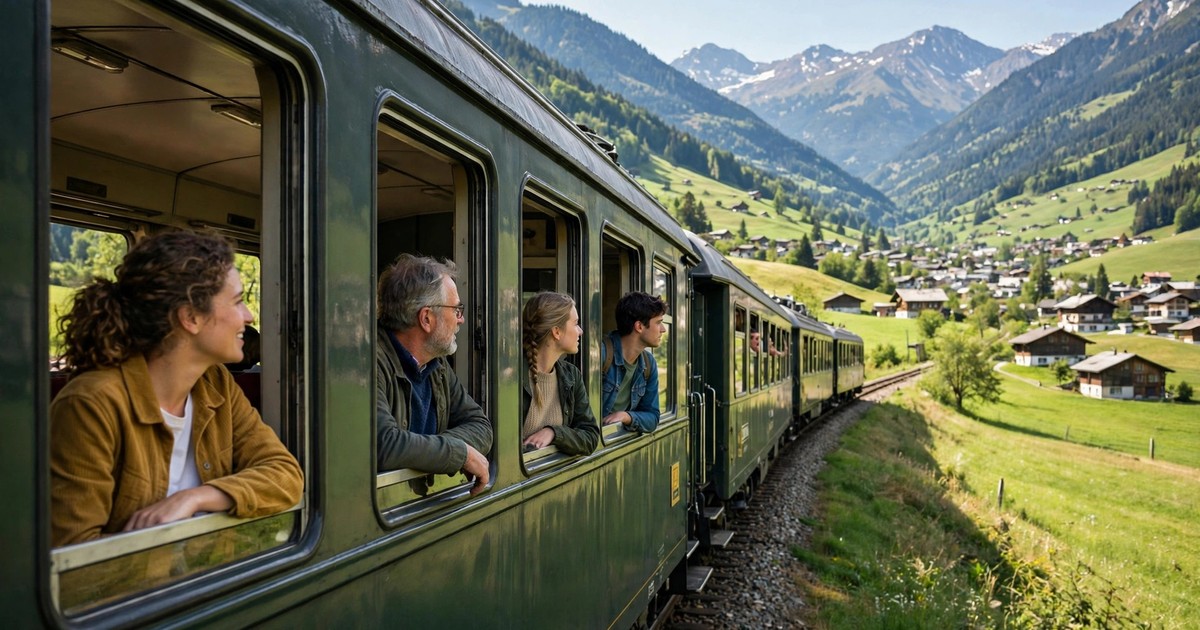
There is a particular freedom that only rail travel gives you in Europe. You arrive in the centre of a city rather than at an airport on its edge, watch the landscape change from farmland to mountains to coastline, and can often decide in the morning to be in another country by lunch. For first-time visitors, a rail pass turns that idea into one simple ticket.
Yet the two names on offer — Interrail and Eurail — confuse almost everyone at first. They sound like rival products, come in several versions, and whether a pass saves money has no single answer. This guide explains how they work, who each is for, what they really cost once reservations are added, and how to avoid common mistakes.
Interrail vs Eurail: The Core Difference
The most important fact is also the simplest: Interrail and Eurail are essentially the same system, sold under two names depending on where you live.
Interrail is for people who live in Europe. Eligibility is based on residency, not just citizenship. If you are a European citizen living outside Europe, or a non-European citizen who legally lives in a European country, check the official eligibility guidance before you buy, because your country of residence decides which pass you need. An Interrail Global Pass is not meant for unlimited travel inside your own country of residence. It normally allows a limited number of travel days there — typically one outbound and one inbound journey — because the pass is designed for exploring other countries.
Eurail is for people who live outside Europe. Visitors from the United States, Canada, Australia, India, Pakistan, Brazil, Japan and most other non-European countries buy a Eurail Pass instead. It works on the same trains, in the same countries, with the same basic rules, and without the home-country restriction, because your home country is outside the network.
Once you are on the train, nobody can tell the two passes apart. The trains, app, reservation systems and travel days work the same way. Both cover more than thirty participating countries in recent years, including France, Germany, Italy, Spain, Switzerland, Austria, the Benelux and Nordic countries, much of Central and Eastern Europe, Greece and Turkey. Coverage can change, so confirm every country on your route is included.
The Main Pass Types Explained
Once you know your name — Interrail or Eurail — you choose the shape of the pass. There are two main decisions: how the travel days work, and how many countries it covers.
Continuous vs Flexi Passes
A continuous pass gives unlimited travel on every day of a set period, such as 15 days, 22 days, one month, two months or three months. If you plan to move almost every day and cover long distances, it can be excellent value and removes all counting.
A flexi pass gives a set number of travel days to use within a longer period — for example 4, 5, 7, 10 or 15 travel days within one or two months. A travel day runs from midnight to midnight, and within it you can take as many trains as you like. Flexi passes suit most first-timers better, because real itineraries include sightseeing days and rest days when you never board a train. You only spend a travel day when you actually travel.
A useful detail: on a direct night train departing after 7 p.m. and arriving after 4 a.m., only the departure day generally counts as a travel day. Confirm the current rule when you activate your pass.
Global vs One-Country Passes
A Global Pass covers the whole participating network and is right if your trip crosses borders — which most classic European rail trips do. A One Country Pass covers a single country, such as France, Italy, Spain or Germany, and can be cheaper if you are exploring one place in depth.
You also choose first or second class. Second class in most of Western and Central Europe is comfortable, clean and perfectly adequate. First class usually means wider seats, more space and a quieter carriage. If your budget is tight, second class is rarely a bad strategy.
Most passes are now mobile passes delivered to the official Rail Planner app rather than paper tickets. You add journeys in the app, activate a travel day, and show the generated ticket to the inspector.
What Does a Pass Really Cost?
Prices vary by age, class, duration and promotions. Youth discounts are usually available for travellers under 28, senior discounts may apply over 60, and young children often travel free with an adult pass holder, subject to conditions and reservation fees. Seasonal sales are common, especially outside peak summer, and can change the maths considerably.
Judge value by your cost per travel day: divide the pass price by the travel days you will genuinely use. If that is less than your long journeys would cost as separate tickets, the pass probably wins; if you will only make two short hops, it probably does not. Remember, seat reservations and sleeper supplements add extra costs, explained below.
Pass vs Point-to-Point Tickets: Which Is Cheaper?
The truthful answer is that it depends on how you travel.
A pass usually wins when:
- You cover long distances or several countries in a short time.
- You want flexibility to change plans or add a stop.
- You book late, when advance fares have already risen.
- Your route uses countries where walk-up fares are expensive, such as Switzerland or Germany.
- You travel in peak season and want certainty about your budget.
Point-to-point tickets usually win when:
- Your itinerary is fixed and known months ahead, so you can buy cheap advance fares.
- You are only making one or two journeys.
- Your route is in countries where regional trains and advance tickets are inexpensive.
- You are happy to commit to a specific train, date and time with no changes.
Many experienced travellers mix the two: a shorter flexi pass for expensive international legs, and cheap advance tickets for short hops that would waste a travel day. Before buying, price your three or four longest journeys as individual tickets, add them up, and compare the total with the pass that would cover them. That simple exercise answers the question for your trip, not someone else’s.
Seat Reservations: The Part Nobody Warns You About
A pass gives you the right to travel; it does not always give you a seat. On many local and regional trains you simply board, activate your travel day and sit anywhere in your class. But on high-speed, long-distance and international trains in countries such as France, Italy and Spain, a seat reservation is often compulsory and costs extra on top of the pass.
Fees vary widely — a small amount on some domestic services, noticeably more on popular international routes and premium services. Night trains require a reservation for a couchette or sleeper berth, and that supplement can be substantial. Some panoramic Swiss services also require reservations even though the pass covers the route.
Build a reservation budget into your plan, book early for peak summer and weekends, and use official channels. Where a slower regional alternative needs no reservation — common in Italy and Germany — it can save the fee entirely. Never board a reservation-only train without one: inspectors can fine you or sell a full-price ticket.
Popular Routes for a First Trip
The grand capitals loop: Paris, Brussels or Amsterdam, then Cologne and Berlin, with London possible via Eurostar subject to its reservation and supplement rules. Fast, frequent trains make this ideal for a first flexi pass.
The Alpine route: Munich, Innsbruck, Verona and Venice, or Zurich through the Swiss Alps to Milan. Mountain scenery from the window is the whole point, and Swiss and Austrian railways are famously reliable.
The Mediterranean arc: Barcelona, southern France, the Italian coast, Rome, Florence and Venice. Beautiful, but plan reservations carefully, because Spanish, French and Italian long-distance trains are the ones most likely to require them.
Central Europe in depth: Prague, Vienna, Budapest and Krakow. Distances are manageable, cross-border fares without a pass add up, and the cities reward slow travel.
The northern journey: Copenhagen, Stockholm and Oslo, with long scenic rail lines. Travel days here cover very long distances, which is exactly where a pass earns its money.
Practical Tips for Using Your Pass
Plan in the app, but check the operator. The Rail Planner app works offline for timetables, which is invaluable, but cross-check important connections with the national railway’s own site or app, especially during engineering works or strikes.
Activate carefully. Only activate your pass and a travel day when you are sure you are travelling. An activated day generally cannot be undone, and activating the pass starts its overall validity period.
Keep your phone alive. A mobile pass means your phone is your ticket. Carry a power bank and keep the app updated; inspectors will want the live ticket in the app.
Arrive a little early at big stations. Hubs such as Paris Gare du Nord or Roma Termini are cities in themselves. Give yourself time to find the platform.
Mind the border basics. A rail pass is a transport ticket, not a visa. You remain responsible for passports, entry rules and any travel authorisation your nationality requires.
Use travel days wisely. Group short journeys into the same day where possible, save travel days for long legs, and use city transport passes or walking on non-travel days.
Common Mistakes First-Timers Make
The most common mistake is buying the biggest pass out of enthusiasm and using only half of it. Count your realistic moving days first, then buy. The second is forgetting reservations and discovering at the platform that the fast train to Paris or Rome needs one. The third is wasting a travel day on a 40-minute hop that would have cost very little as a separate ticket.
Other errors include assuming every train is covered — some private, airport and tourist trains are not — forgetting Eurostar quotas and supplements, travelling with an unactivated pass, and leaving no buffer before a flight home.
Frequently Asked Questions
Can I buy both Interrail and Eurail and choose later?
No. You buy the one matching your country of residence: Interrail if you live in Europe, Eurail if you live outside it. They cover the same network, so there is no advantage in holding the other version.
Does a rail pass include Eurostar to London?
Passes can be used on Eurostar, but a separate reservation is compulsory, pass-holder places are limited, and you should book well in advance, especially in summer. Check the current conditions before counting on this route.
What happens if my train is cancelled or I miss a connection?
Keep your travel day activated, speak to station staff, and take the next available service where possible. Staff across Europe deal with this daily. Note announcements if you later need to explain a delay to customer service.
Is first class worth it?
For most first-timers, second class is good value and entirely comfortable. First class is a nice upgrade on long days, busy routes or special scenic journeys, but rarely essential. Spend the difference on reservations, food or an extra night instead.
Sources / Note
This article is an original general guide for planning purposes. Pass types, prices, discounts, participating countries, reservation rules and night-train conditions change regularly. Before buying, check the official Interrail website (interrail.eu) and the official Eurail website (eurail.com), plus the national railway operator for each country on your route, for current prices, eligibility and reservation requirements. Facts in this article should always be checked against those official sources before you travel.
Leave a Reply