
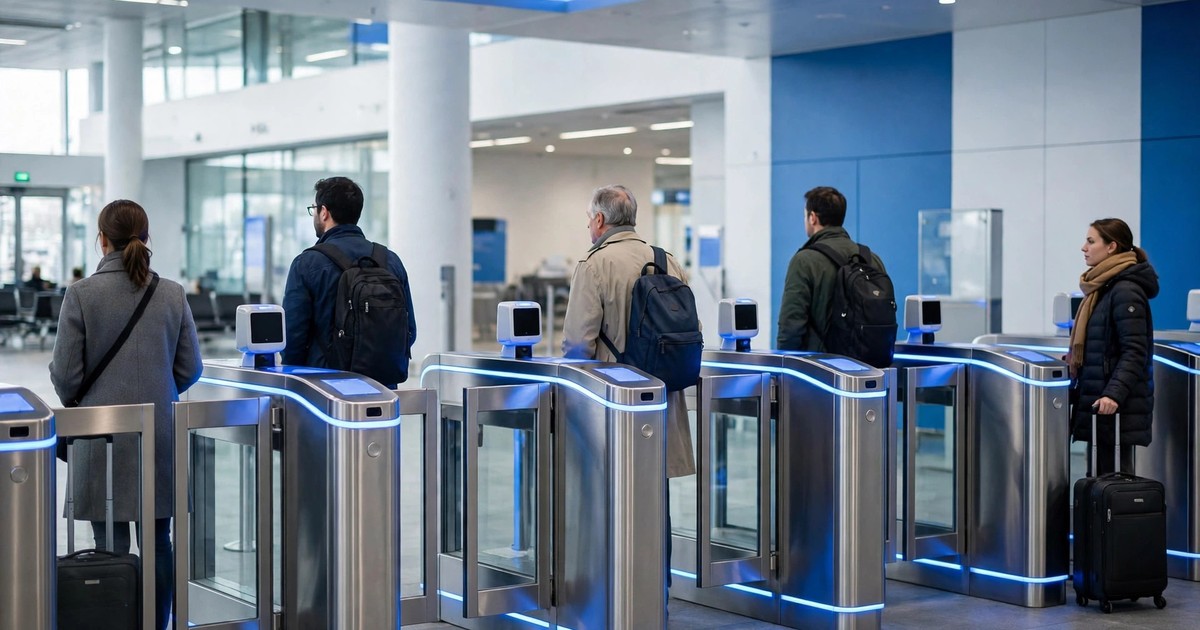
For decades, arriving in Europe as a visitor from outside the EU has meant one ritual: a border officer opens your passport, finds a blank page and presses down a stamp. Those stamps were more than souvenirs — they were the official record of when you entered and left, and the only practical way to count how long you had stayed.
That system is now being replaced by the EU’s digital Entry/Exit System, usually shortened to EES, which records entries and exits electronically instead of with ink. Its rollout has been debated and delayed more than once, and it is being introduced in a phased way rather than everywhere on a single morning. If you visit Europe from outside the EU, EES will affect you in ways worth understanding before you reach the border.
This guide explains what EES is, who it applies to, what happens at your first crossing, how it changes the famous 90/180 day rule, and how it differs from ETIAS, the separate travel authorisation system often confused with it.
What Is the Entry/Exit System (EES)?
The Entry/Exit System is an automated EU border management system that registers non-EU travellers each time they cross the external borders of the participating European countries for a short stay. Instead of relying on passport stamps, border authorities create a digital record of your entry and exit.
That record is designed to include basic information from your travel document, the date and place of your crossing, and biometric identifiers — a facial image and, in most cases, fingerprints. The system links those crossings together, so authorities can see whether a traveller entered, when they left, and whether they stayed within the permitted period.
The EU’s aims are practical and security-related: modernise border checks, make overstay calculations automatic, reduce identity fraud, and eventually speed crossings through automation. Manual stamping was slow, stamps could be illegible or missing, and counting days from faded ink was error-prone.
EES applies at the external borders of the European countries that use it — broadly, the Schengen area countries. Ireland, in the EU but outside Schengen, does not operate the same system, and Cyprus’s position has differed from the full Schengen group. Confirm the current participating countries on the official EU EES pages before a trip.
Who Does EES Apply To?
EES is aimed at non-EU nationals travelling for a short stay. In general terms, that means visitors from countries whose citizens can enter the Schengen area visa-free for tourism or business — such as the United Kingdom, the United States, Canada, Australia and many others — as well as travellers who hold a short-stay Schengen visa.
A short stay generally means up to 90 days in any 180-day period across the participating countries as a whole, not 90 days per country. That rule existed long before EES; what changes is how precisely it is recorded and checked.
EES does not generally apply to:
- Citizens of EU and Schengen-associated countries, who use their own lanes and documents.
- Non-EU family members holding a residence card issued under EU free-movement rules, in the circumstances covered by official guidance.
- People holding a residence permit or long-stay visa from a participating country, who live there legally rather than making a short visit.
- Certain specific categories in the official rules, such as some diplomats and cross-border workers with special status.
In short: if you are a non-EU citizen making a short visit without a residence permit or long-stay visa, assume EES applies to you. Children are also registered in general terms, although biometrics collected can differ by age — younger children’s fingerprints are treated differently. Check official guidance for the exact current thresholds.
What Happens at Your First Crossing?
Your first crossing under EES will take a little longer than later ones, because that is when your digital file is created.
Expect this process. You present your passport as usual. The officer — or, at some borders, a self-service kiosk first — captures a live facial image and scans your fingerprints. Your document details and the date and place of entry are recorded, and your file is created or updated. You may be asked standard questions: the purpose of your visit, how long you will stay, and where.
At later crossings, the system can usually verify you against the file it holds, often using the facial image, so the process should be quicker. At exit, your departure is recorded, closing the entry — something stamps were supposed to do but often did inconsistently.
The system operates at airports, seaports, land borders and international rail terminals, including juxtaposed controls for cross-Channel journeys, where checks happen before departure. Facilities differ: a major hub may have kiosks and e-gates, while a small land crossing may use a booth. During the phased introduction, procedures may vary, and some crossings may still stamp passports in a transition period.
Build extra time into your first journey under the new system, particularly at busy periods. Early queues are usually about unfamiliarity and volume, not your documents.
The End of Passport Stamps
Once EES is fully in operation at a border, manual stamping of passports for travellers covered by the system is meant to end, because the electronic record replaces it. Your entry and exit history lives in the system rather than on your passport pages.
Practically, you lose the informal proof stamps provided, so keep your own records: boarding passes, booking confirmations and a note of entry and exit dates. In return, problems with a missing or illegible stamp largely disappear once crossings are digital and timestamped by the system itself.
During a phased rollout, practice may differ between borders — one airport may register you digitally while another still stamps. Follow local instructions on the day.
How the 90/180 Day Rule Is Tracked Now
The rule itself has not changed: visa-free short-stay visitors may spend up to 90 days in any rolling 180-day period in the Schengen area. What EES changes is enforcement and accuracy.
Under stamping, counting days meant working backwards through stamps, sometimes across several trips. Under EES, the system calculates automatically, flags travellers with no days remaining or who have overstayed, and identifies entries with no matching exit.
The informal flexibility some travellers assumed existed is gone. A miscounted week or a hope that a new passport resets the count will not survive a digital record. Use the EU’s official short-stay calculator where available, track your days, and remember they count across the whole area: a month each in Spain, France and Italy is 90 days used.
An overstay can have serious consequences, including fines, removal and future entry bans, depending on the country and circumstances. If you realise you have a problem, taking legal advice early is far better than hoping the system has not noticed — under EES, it very likely has.
EES vs ETIAS: Two Systems, Often Confused
EES and ETIAS are frequently mentioned in the same sentence, which causes endless confusion. They are different systems doing different jobs, on different timetables.
EES is a border system. It registers what actually happens when you cross: your entry, your exit and your biometrics. There is no application to complete in advance and no fee for being registered. You do not apply for EES; you are recorded by it at the border.
ETIAS is a travel authorisation for visa-exempt visitors, similar in spirit to the US ESTA. Eligible travellers will apply online and pay a fee before travelling, receiving an authorisation linked to their passport. It is pre-travel screening, not a border record, with its own phased start arrangements.
In plain terms: ETIAS, once it applies to you, is arranged before you fly; EES happens when you land. Many visitors will eventually deal with both, so check the official pages for each rather than social media summaries, which regularly merge them.
Privacy and Data Retention in General Terms
Because EES collects biometrics, privacy questions are reasonable and were part of the debate around its design. In general terms, the system is governed by EU law that sets out what data is collected, who may access it and how long it is kept.
Under the official framework, EES records are retained for a defined period — generally three years from the relevant exit or entry record — with longer retention possible where there is no recorded exit, reflecting a possible overstay investigation. Access is limited to authorised bodies such as border, visa and immigration authorities, with law enforcement access under strict conditions. Travellers have rights in principle to access their data and request correction of inaccuracies.
Exact retention periods and access conditions are legal details that can be amended, so treat this as a general picture, not legal advice. The official EU EES website and European Commission pages set out the current rules, and your own government’s travel advice usually summarises them for its citizens.
Practical Tips to Avoid Delays
- Arrive with time to spare. For your first EES crossing especially, allow extra time at the border, and avoid tight onward connections immediately after arrival.
- Use the right lane and follow local instructions. Signage and staff will direct non-EU travellers to kiosks or booths. Procedures vary by airport and port during the rollout.
- Have your documents ready. Passport in hand, and be ready to state your destination, length of stay and accommodation, just as officers have always been able to ask.
- Keep your own day count. Track your Schengen days in a note or app, keep boarding passes and bookings, and never rely on a stamp — or its absence — as your record.
- Do not try to game the system. A new passport, a land border instead of an airport, or a missing exit record does not reset your allowance under a linked digital system.
- Check official sources before you travel. Rollout stages and temporary arrangements are updated on the EU’s official EES pages.
Frequently Asked Questions
Do I need to apply or pay for EES before I travel?
No. EES is not an application or a visa. You are registered at the border when you cross, and there is no EES fee. The system people sometimes mean is ETIAS, which is separate and has its own application process and timetable.
Will my passport still be stamped?
Once EES is fully operating at the border you use, stamping for travellers covered by EES is intended to stop, because the digital record replaces it. During the phased introduction, practice may vary, so follow the procedure at your specific crossing.
Does EES change how long I can stay in Europe?
No. The 90 days in any 180-day period rule for short stays is unchanged. EES simply records and calculates it automatically, which makes accurate counting — and overstays — much easier to detect.
What if the system shows a wrong entry or exit for me?
Raise it with the border authority at the time if you can, keep your own evidence such as boarding passes and booking records, and use the official channels described on the EU EES pages to request correction of inaccurate data.
Sources / Note
This article is an original general explainer and does not replace official guidance. EES is being introduced in a phased, recent rollout, and start dates, participating borders and procedures have changed before and may change again; this article deliberately avoids presenting any single date as certain. Before travelling, check the EU’s official EES pages (travel-europe.europa.eu and related official EU pages), the official ETIAS pages, and your own government’s travel advice. Facts here should always be checked against those official sources.
Leave a Reply