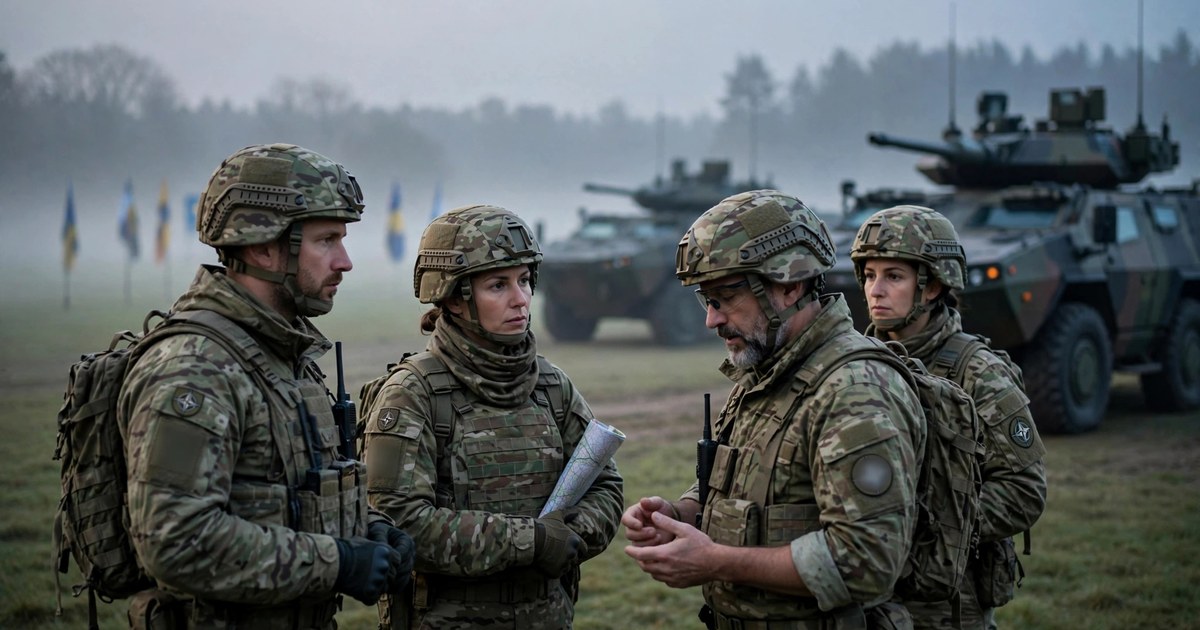
For three decades after the Cold War, most European governments reduced the share of national income spent on defence. Armies became smaller, equipment stocks were cut, and many countries assumed a large-scale war on the continent had become unlikely. That assumption has now been reversed. Defence budgets are rising at their fastest pace in a generation, new targets are being debated inside NATO, and the European Union is building tools to fund and coordinate military production.
This article explains why spending is increasing, what the NATO targets mean, how countries compare, what the EU is doing, and what the debate means for ordinary citizens.
The Turning Point: Russia’s Full-Scale Invasion of Ukraine
The clearest turning point was Russia’s full-scale invasion of Ukraine in February 2022. Russia had annexed Crimea and backed armed groups in eastern Ukraine from 2014, but the 2022 invasion was a large conventional war involving missile strikes, armoured offensives, and attacks on cities and infrastructure across an entire country.
It changed European security calculations in several ways. It showed that a major war of territorial conquest was possible in Europe again, not only a limited or hybrid conflict. It exposed how quickly modern warfare consumes ammunition, air-defence missiles, drones, and spare parts — far faster than many peacetime stockpiles were designed to support. And equipment donated to Ukraine left gaps in national inventories that governments then had to pay to refill.
Germany’s announcement in 2022 of a special fund of 100 billion euros for its armed forces, described by its chancellor at the time as a turning point, became the best-known symbol of the shift. But the change was broader. Poland sharply increased its budget and placed large orders for tanks, artillery, and aircraft. The Baltic states and Nordic countries accelerated existing plans. Finland joined NATO in 2023 and Sweden in 2024, ending long periods of military non-alignment.
Spending had already begun to rise after 2014, but the post-2022 increase was larger, faster, and spread across more countries.
What Is NATO’s 2 Percent Guideline?
NATO does not set national budgets. It agrees political commitments among member governments, which are then reflected — or not — in national budgets.
In 2014, NATO leaders agreed at the Wales Summit that members spending below 2 percent of gross domestic product (GDP) on defence would aim to reach 2 percent within a decade, and to spend 20 percent of their defence budgets on major new equipment. GDP is the total value of goods and services produced in a country in a year, so a share of GDP allows comparison between economies of very different sizes.
For years, only a handful of European members met the figure. According to NATO’s estimates, that changed sharply after 2022, and by 2024 a clear majority of allies — 23 of 32 members, including most European members — were estimated to be at or above 2 percent.
NATO’s common definition matters when reading these figures. Its measure can differ from a country’s own headline budget number, because it uses agreed categories for personnel, equipment, infrastructure, and pensions. Two figures for the same country in the same year can therefore both be correct, depending on the definition used.
The Debate About Higher Targets
Meeting 2 percent is no longer the end of the discussion. Members have debated whether the old guideline is sufficient for the capabilities the alliance now says it needs: more air and missile defence, larger ammunition stocks, long-range weapons, drones and counter-drone systems, cyber and space capabilities, and the logistics to move forces across Europe quickly.
At the NATO summit in The Hague in June 2025, allies agreed a new, higher commitment: 5 percent of GDP by 2035, split into 3.5 percent for core defence requirements and 1.5 percent for defence- and security-related investment such as infrastructure, resilience, and industrial capacity. Supporters say this separates direct military spending from wider spending that supports defence, such as transport infrastructure able to carry heavy equipment.
Governments closest to Russia generally argue that higher spending responds to a long-term threat, and that capability targets — what forces can actually do — should drive budgets. Others, including Spain during the summit discussions, raised concerns about reaching such a level quickly without affecting other public commitments, and sought flexibility. The United States, under successive administrations, has also pressed European allies to carry a larger share of the cost of Europe’s conventional defence, making burden-sharing a recurring transatlantic theme.
Analysts note that a percentage of GDP does not by itself guarantee useful output: one country may spend largely on personnel and pensions, while another buys modern equipment more efficiently, especially jointly. NATO therefore also tracks equipment spending and capability targets.
Which European Countries Spend the Most and the Least?
Patterns differ considerably, reflecting geography, history, and threat perception.
In percentage-of-GDP terms, Poland has in recent years recorded the highest defence spending in NATO, at well above 4 percent of GDP in NATO’s 2024 and 2025 estimates, driven by a large modernisation programme. The Baltic states — Estonia, Latvia, and Lithuania — have also consistently been among the highest spenders as a share of GDP, and plan to move higher still. Greece has historically spent a high share, shaped by its long-standing tensions with Türkiye, although much of it has traditionally gone to personnel. The United Kingdom, France, and Germany are Europe’s largest spenders in absolute cash terms because their economies are large, even when their percentages sit closer to the middle of the range.
At the lower end, Spain, Belgium, Luxembourg, Slovenia, and Italy spent below or only near 2 percent for much of the past decade, according to NATO estimates, though several have since announced phased increases. Ireland, an EU member but not a NATO member, spends a particularly small share of GDP on defence and maintains military neutrality, so its debate is separate.
The broad picture is consistent: eastern and northern states closest to Russia tend to spend the highest shares, while several western and southern states are increasing from a lower base.
What the European Union Is Doing
NATO remains the main organisation for collective defence planning for its members, but the European Union has expanded its role on the industrial and financial side. The EU cannot command national armies, yet it can fund research, support joint buying, and use its budget and regulatory powers to strengthen the defence industry.
Key steps include the European Defence Fund, which co-finances collaborative research and development involving companies from several member states. After 2022, the EU also adopted measures to encourage joint procurement of ammunition and equipment, and to expand ammunition production capacity in Europe. In 2025, the European Commission presented further readiness plans, including a large loan instrument known as SAFE, intended to help member states borrow jointly on favourable terms for defence investment, and proposals for more flexibility in EU fiscal rules for defence spending.
The European Defence Agency also helps coordinate: it collects defence data, identifies duplicated or missing capabilities, and supports cooperative projects. Its annual data is a main source for comparing European spending outside NATO’s figures.
The two efforts overlap but are not identical. Twenty-three countries belong to both organisations, so the same budget often has to meet NATO capability targets while using EU tools to buy equipment more cheaply or produce it in Europe. Debate continues over whether EU programmes should favour European suppliers, or buy more quickly from outside suppliers, including the United States and South Korea, when equipment is needed urgently.
Arguments For and Against Higher Spending
Supporters make several arguments. The first is deterrence: visible capability and readiness, they argue, reduce the risk of attack, and prevention costs less than war. The second is credibility within NATO: meeting agreed targets is presented as keeping a political commitment and maintaining US engagement in European security. The third is industrial: sustained orders can rebuild production lines for ammunition, vehicles, and air defence that were allowed to shrink, creating skilled jobs. The fourth is continued support for Ukraine, which requires European equipment and ammunition.
Critics raise different concerns. One is opportunity cost: money directed to defence is not spent on health care, education, housing, pensions, or climate investment, and several governments already carry high public debt. Another is efficiency: rapid increases can lead to rushed purchases, rising prices from a limited number of suppliers, and equipment expensive to maintain. A third is public consent — voters may support defence in principle but resist tax rises, borrowing, or cuts elsewhere. Some analysts also argue that Europe’s core problem is fragmentation, with many small national fleets of different tanks, ships, and aircraft, and that better coordination could deliver more capability without every country simply spending more in isolation.
What It Means for Ordinary Citizens
For most citizens, the debate arrives through national budgets. Governments have three broad ways to pay: raise revenue, borrow more, or spend less elsewhere. Countries are choosing different mixes. Some have created special funds or used EU loans; others have adjusted fiscal rules or announced phased increases over a decade, which softens the immediate effect but commits future budgets.
Defence investment can also bring jobs and contracts to regions with factories, shipyards, or research centres, and infrastructure spending linked to defence can include upgrades to ports, railways, and bridges used by both civilian and military traffic.
In some countries, the discussion extends to military service. Lithuania, Latvia, Sweden, and Germany are among the states that have reintroduced, expanded, or debated forms of conscription or voluntary national service in recent years, while Croatia has announced plans to restore compulsory service. Others, including the United Kingdom and France, have debated expanded voluntary or civic service models rather than full conscription. These policies affect young people directly and are often the most personally felt part of the shift. They remain national decisions; there is no EU-wide or NATO-wide conscription policy.
FAQ
Is NATO forcing European countries to spend 5 percent of GDP?
No. NATO commitments are political agreements between governments, not laws enforced by NATO. Each parliament still approves its own budget. The 2025 commitment sets a shared target of 5 percent by 2035, divided between core defence and wider security-related investment, but pace and method remain national decisions.
Why is spending measured as a percentage of GDP?
Because it allows comparison between countries of very different sizes and shows the share of national resources devoted to defence. It is imperfect — it does not show how efficiently money is used — which is why NATO and the European Defence Agency also publish data on equipment spending and capabilities.
Do all European countries belong to NATO?
No. Most EU member states are also NATO members, but Austria, Ireland, Malta, and Cyprus are EU members outside NATO, while several European NATO members, including the United Kingdom, Norway, and Türkiye, are outside the EU. Switzerland is in neither.
Will higher defence spending mean cuts to public services?
Not automatically, but the trade-off is real over time. Governments can borrow, raise revenue, use special funds, or reprioritise spending, and most are using a mixture, with increases phased over years.
Sources and Note
This explainer is an original summary written for TheEuropeTimes.site and does not reproduce text from any news outlet. The facts rest on official and research sources of the following types: NATO’s official defence expenditure reports and summit declarations, including the 2014 Wales Summit pledge and the 2025 Hague Summit commitment; European Defence Agency annual defence data; European Commission and Council of the EU documents on the European Defence Fund, joint procurement instruments, and the SAFE loan facility; national government budget documents and defence ministry announcements; and independent research and military expenditure data from the Stockholm International Peace Research Institute (SIPRI). Figures are given in general terms because estimates are revised regularly; readers should consult the latest NATO and European Defence Agency releases for exact figures by country and year.
Leave a Reply