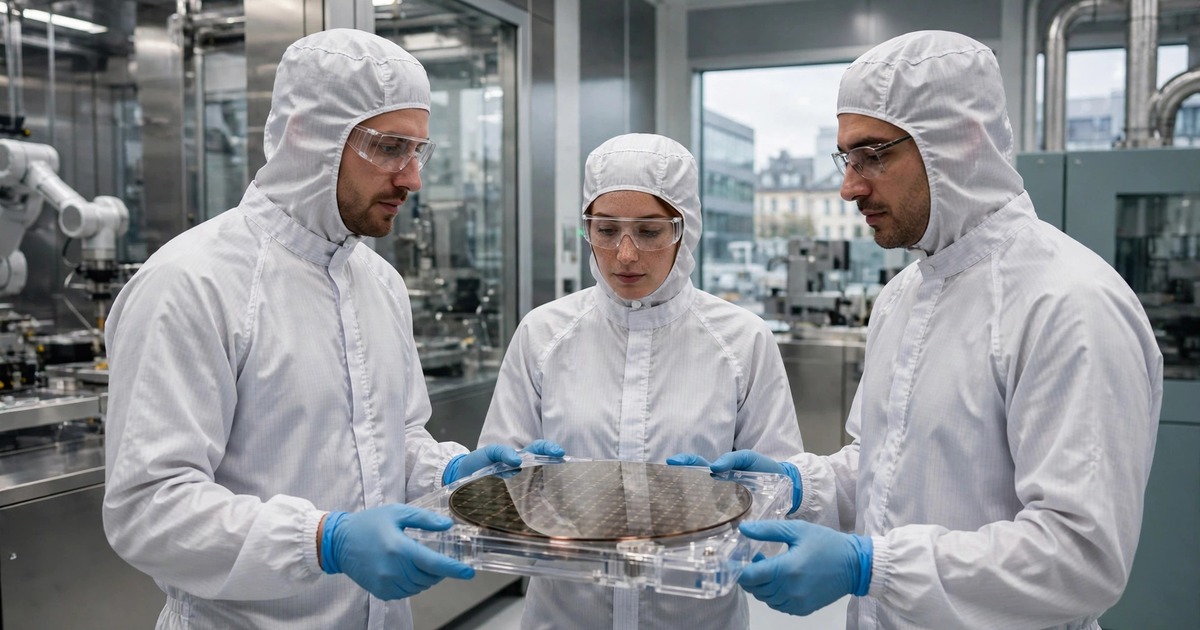
For decades, Europe was comfortable being a customer of technology made elsewhere. Its phones ran on American software, its computers used chips designed in California and manufactured in Taiwan, and its companies stored data on cloud platforms owned by firms from Silicon Valley. That arrangement worked while trade was open and supply chains were reliable. It has stopped feeling safe. A pandemic that shut down factories, a war on Europe’s own continent, export controls between the United States and China, and the explosive arrival of artificial intelligence have convinced European governments that depending on others for the most strategic technologies of the century is a risk they can no longer accept. The result is a race — funded with hundreds of billions of euros — to build a European AI and semiconductor industry. This article explains why the race started, what Europe is building, where it is strong, where it is far behind, and what success or failure would mean.
The wake-up calls
The first shock came during the Covid-19 pandemic, when car factories across Germany, France and Spain stopped production lines not for lack of workers or customers, but for lack of chips costing a few euros each. Modern cars, washing machines, medical devices and industrial robots all depend on semiconductors, and when Asian factories closed and shipping seized up, Europe discovered it produced only a small fraction of the chips it consumed. Industry estimates commonly cited by the European Commission put Europe’s share of global chip production at around ten percent, down from much higher levels in the 1990s.
The second shock was geopolitical. The United States restricted China’s access to advanced chips and chipmaking tools, and China in turn tightened controls on raw materials such as gallium and germanium that chip production needs. Europe found itself caught between two superpowers, dependent on both and fully in control of neither. At the same time, Russia’s full-scale invasion of Ukraine exposed how quickly energy dependence can be weaponised, and policymakers drew an obvious parallel: a continent that had relied on Russian gas did not want to rely indefinitely on a handful of foreign suppliers for computing power.
The third shock was artificial intelligence itself. The launch of powerful generative AI systems from 2022 onwards showed that the next wave of economic growth — and military capability — would be built on advanced chips, vast data centres and large computing clusters. Almost all of the leading systems came from American companies, trained on American-owned infrastructure. European leaders began using a new phrase: technological sovereignty. The race is the practical meaning of that phrase.
What Europe is actually building: the Chips Act
Europe’s main semiconductor policy is the European Chips Act, which entered into force in 2023. Its headline ambition is to raise Europe’s share of global chip production from roughly ten percent to twenty percent by 2030, and to mobilise more than €43 billion in public and private investment. The act works in three ways. It funds research and pilot production lines so European designs can be tested at small scale before mass manufacturing. It makes it easier for governments to subsidise large factories — known in the industry as fabs — that are the first of their kind in Europe. And it creates monitoring and crisis-response mechanisms so that future shortages are spotted earlier.
Money has followed the law. Intel announced a major plant in Magdeburg, Germany; TSMC, the Taiwanese giant that makes most of the world’s advanced chips, joined with European partners to build a factory in Dresden; STMicroelectronics, Infineon and GlobalFoundries have expanded sites in France, Germany and Italy. Not every project has run smoothly — some have been delayed or scaled back as costs rose and demand shifted — but the direction is clear: Europe is paying to bring production home.
The AI side of the race: gigafactories and supercomputers
Chips are only half the story. Training and running modern AI models requires enormous computing facilities, and Europe has moved to build its own. The EU’s InvestAI initiative, announced in 2025, aims to mobilise around €200 billion for artificial intelligence, including a fund for European AI gigafactories — very large data centres equipped with tens of thousands of advanced processors, intended to give European researchers and companies computing power comparable to what American tech giants own privately.
Alongside this, the EU’s network of supercomputers, coordinated through the EuroHPC programme, is being opened to AI work. Machines such as LUMI in Finland and Jupiter in Germany rank among the most powerful in the world, and a network of smaller "AI factories" around them is meant to give startups, universities and public bodies access without each having to build their own infrastructure. The logic is simple: if computing power is the raw material of the AI age, Europe wants some mines of its own.
Where Europe is already strong
The race does not start from zero, and Europe’s strongest card is one most people have never heard of. ASML, a Dutch company, is the only firm in the world that makes the extreme ultraviolet lithography machines needed to produce the most advanced chips. Every leading chipmaker on earth — in Taiwan, South Korea and the United States — depends on ASML’s equipment. Europe also has strong positions in the machinery, chemicals and materials that surround chipmaking, in automotive and industrial chips through companies such as Infineon, NXP and STMicroelectronics, and in research institutes such as imec in Belgium, Fraunhofer in Germany and CEA-Leti in France, which are woven into the global industry’s development work.
In AI, Europe’s position is weaker but not empty. France’s Mistral AI has become one of the most prominent independent AI labs outside the United States, and Germany, the Nordic countries and the Netherlands host growing clusters of AI startups and research talent. European universities produce world-class researchers — although, as discussed below, too many of them leave.
Where Europe is far behind
Honesty about the gaps explains the urgency. Europe has no company comparable to Nvidia, which dominates the AI accelerator chips that power modern data centres, and no cloud provider on the scale of Amazon, Microsoft or Google, which together control most of the infrastructure on which AI services run. The overwhelming majority of the world’s most advanced chips are manufactured in Taiwan and South Korea, and building competitive production in Europe takes years and tens of billions of euros per facility.
Money is a second gap. American technology firms each spend more on research and data centres in a year than many European national programmes spend in a decade, and Europe’s fragmented capital markets make it harder for a startup to raise the very large funding rounds that AI companies need. The result is a familiar pattern: a company founded in Europe moves its headquarters, listing or main operations to the United States as it grows. Regulation is debated too. The EU’s AI Act, the world’s first comprehensive AI law, is praised for protecting citizens and criticised — including by European founders — for adding compliance costs that smaller firms struggle to carry. Europe is trying to simplify and support while it regulates, but the tension is real.
Energy is a third constraint. Data centres consume vast amounts of electricity, and European industrial energy prices are higher than American ones. A gigafactory strategy therefore depends on grid connections, permits and access to affordable low-carbon power — unglamorous issues that can decide whether announced projects actually get built.
Why governments are willing to pay
Subsidising chip factories and data centres is expensive, and European taxpayers are entitled to ask why. The official answer has three parts. The first is security: chips and AI are now dual-use technologies, central to modern weapons, communications and intelligence, and defence planners do not want supply controlled elsewhere. The second is economic insurance: the car industry alone employs millions of Europeans, and the pandemic showed how a missing component can halt it; a domestic supply base is a hedge against the next crisis, whether caused by a blockade, an earthquake in a chip region or a trade war. The third is opportunity: AI is expected to reshape productivity across every sector, and governments believe that countries which only buy the technology will capture less of its value — fewer headquarters, fewer high-paid jobs, less tax revenue — than countries which also build it.
Critics answer that subsidies can waste money, that twenty percent targets may be unreachable, and that Europe would gain more by specialising in what it already does best. The debate is genuine, but so far the political consensus across the EU has held: doing nothing is seen as the riskiest option.
What this means for ordinary people
For most Europeans, the race will be visible in indirect ways. It means construction and engineering jobs around new plants in places such as Dresden and Magdeburg, and demand for technicians, electricians and process engineers across the supply chain. It means new training programmes, because factories and data centres are useless without skilled staff. It may mean that future European AI services — in healthcare, public administration, education and industry — run on European infrastructure under European data rules, which matters for privacy and for how complaints and accountability work. And it is one reason electricity grids, planning rules and technical education have become central political topics rather than background administration.
The outlook
Europe will not overtake the United States or China in AI and chips by 2030, and no serious policymaker claims otherwise. The realistic goal is narrower: to hold irreplaceable positions such as ASML’s, to produce enough chips on European soil that a crisis cannot paralyse its industries, to give its researchers computing power they control, and to keep more talent and firms at home. Whether the money is spent well enough to achieve even that will be decided by execution — permits issued, power connected, factories finished — rather than by announcements. The race is real, it is expensive, and its result will shape Europe’s economy and security for a generation.
Frequently Asked Questions
What share of the world’s chips does Europe make?
Estimates commonly used by the European Commission put Europe’s share at around ten percent of global production. The European Chips Act aims to raise that share to twenty percent by 2030.
What is the European Chips Act?
It is the EU law, in force since 2023, that funds chip research and pilot lines, allows governments to support first-of-a-kind factories in Europe, and sets up monitoring for future shortages. It aims to mobilise over €43 billion in combined public and private investment.
What is an AI gigafactory?
A very large data centre filled with advanced processors for training and running AI models. The EU’s InvestAI initiative supports building several in Europe so that European researchers and companies are not wholly dependent on American-owned computing infrastructure.
Which European company is most important in the chip industry?
ASML of the Netherlands. It is the only maker of the extreme ultraviolet lithography machines required for the most advanced chips, so every leading chip manufacturer worldwide depends on its equipment.
Does Europe have any leading AI companies?
Europe’s AI sector is smaller than America’s, but it includes prominent firms such as France’s Mistral AI, strong research universities, and growing startup hubs in Paris, Berlin, Amsterdam, Stockholm and other cities.
Sources / Note
This explainer is based on primary and official sources of the kind that document industrial policy directly: the European Chips Act and European Commission materials on semiconductor market share and investment; Commission announcements on the InvestAI initiative and AI gigafactories; EuroHPC programme documentation on European supercomputers; and published company announcements by ASML, Intel, TSMC and their European partners regarding factory projects. Investment figures, market-share estimates and project timelines change as programmes are revised and projects are delayed or expanded, so readers should check the European Commission’s digital strategy pages and company statements for the current status of specific projects.
Leave a Reply